Efficiency of use
Severity 3
While swiyu makes requested information visible before consent, reviewing and completing multiple requests increases interaction effort.


From a 3-Day Manual Queue to a <60-stateful onboarding experience
View prototype v2.0
Foundations
The design principles in this case study (selective disclosure, user-held credentials and unlinkable use) build on the self-sovereign identity model described by Alex Preukschat and Drummond Reed in Self-Sovereign Identity (Manning, 2021).
Manning · Self-Sovereign Identity (2021)#2 RESEARCH
How might reusable, trusted digital credentials in the Swiss E-ID ecosystem enable a faster bank onboarding experience while minimising the personal information customers need to disclose?
#1 OUTLINE
How might a traditional Swiss bank integrate swiyu into account opening while reducing manual verification and giving customers greater transparency and control over their data?
AlpenBank is exploring how digital credentials could support a more continuous onboarding experience while still meeting the bank's KYC, AML and tax-reporting obligations. Traditional digital onboarding still requires customers to repeatedly provide and verify information. With Swiss E-ID and swiyu, trusted credentials create an opportunity to change that model.
1.
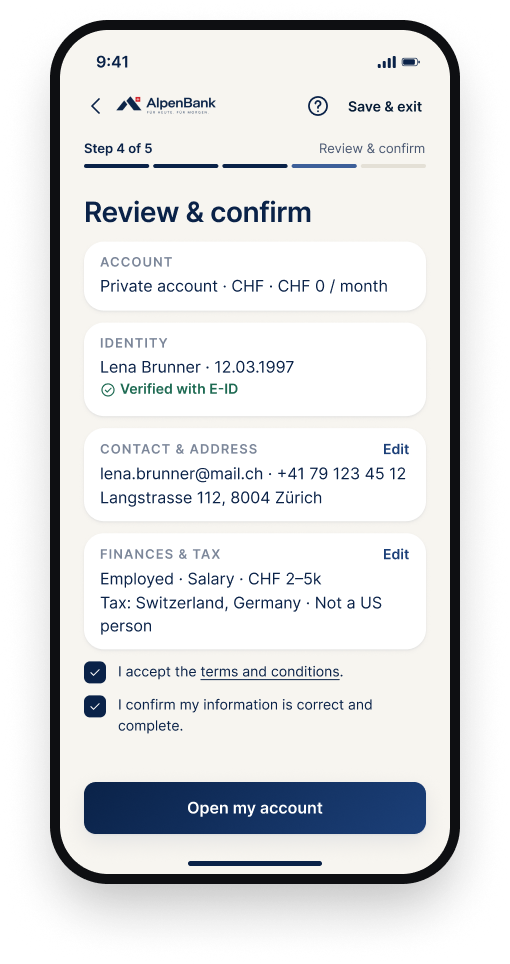
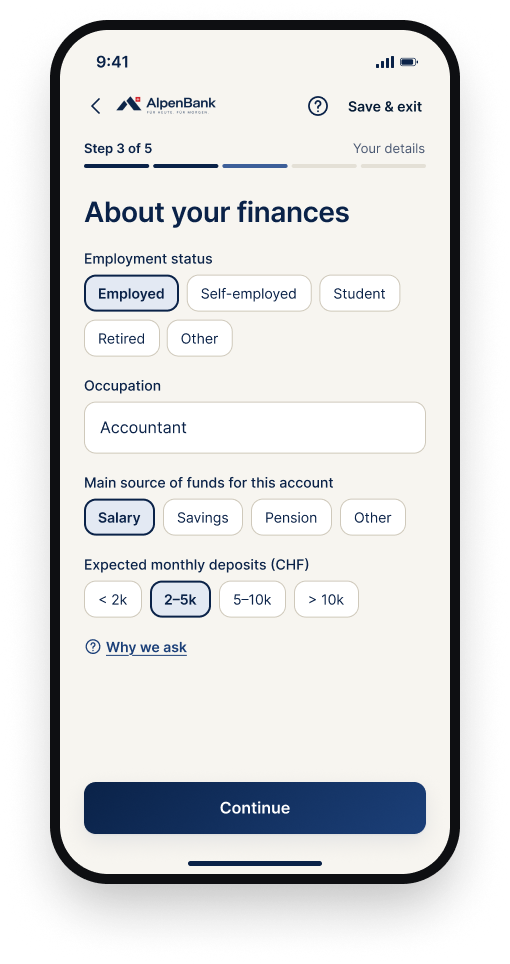
The bank still needs information to complete its customer dossier. This creates friction for the user experience.
2.
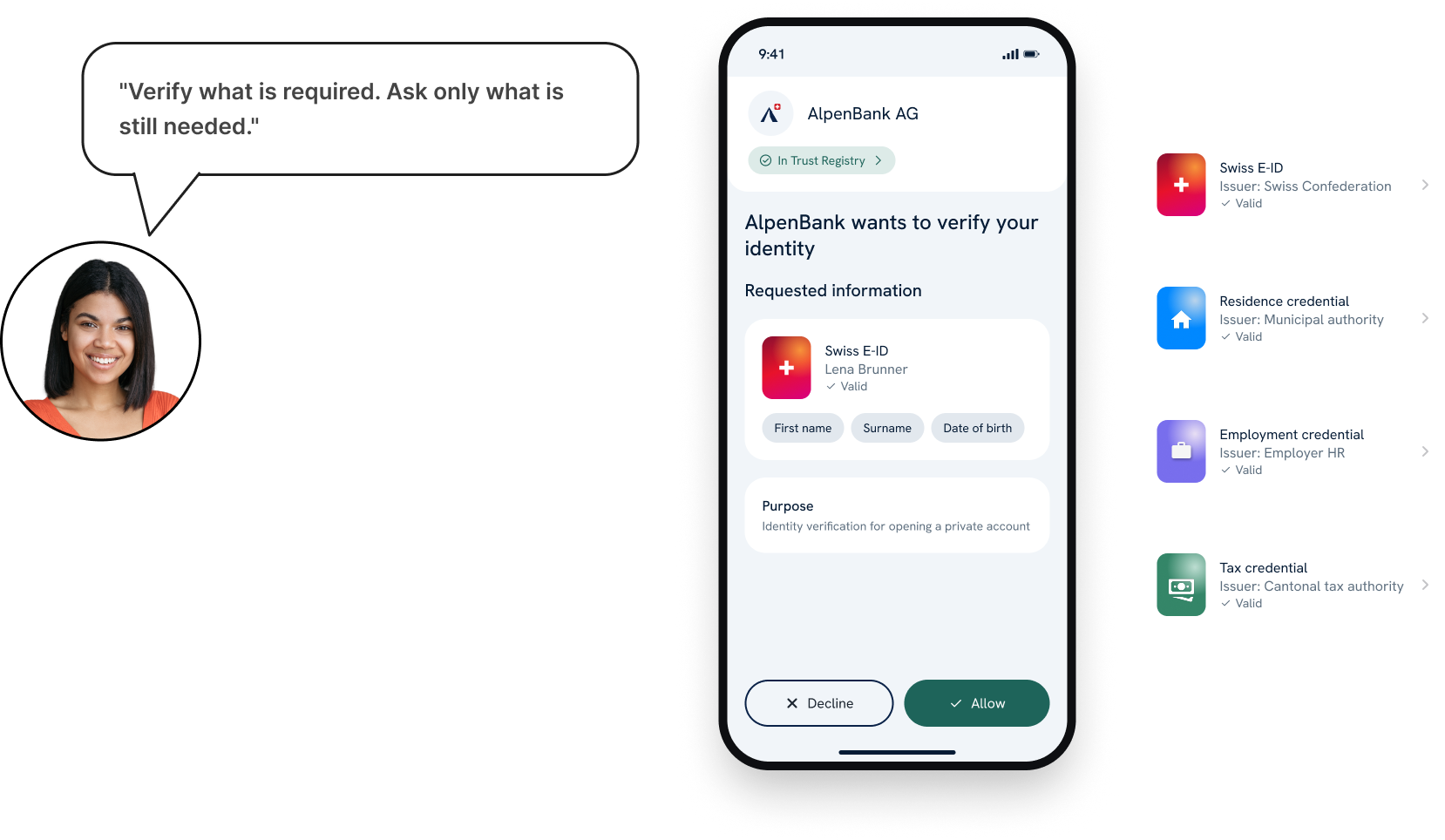
Before consenting, users need to understand who is requesting their information, what is requested and why.
3.
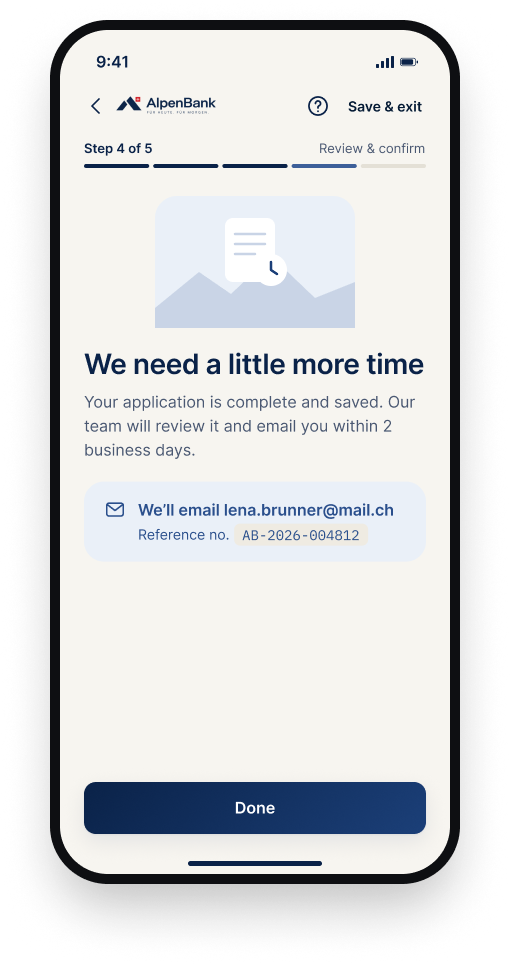
A successful E-ID verification does not necessarily mean the bank's wider KYC process is complete.

9:41





Für heute. Für morgen.
Banking made in
Switzerland.
Open your private account in minutes,
verified with your Swiss E-ID.
Open an account
Log in
#3 HEURISTIC EVALUATION
I evaluated the hybrid bank–swiyu journey against Nielsen Norman Group's 10 usability heuristics, focusing on cross-device continuity, consent, information disclosure and recovery.
View full heuristic evaluation →
Severity 3
While swiyu makes requested information visible before consent, reviewing and completing multiple requests increases interaction effort.
Severity 2
Users need to understand what has already been verified and what remains before account opening.
Severity 2
Users should be able to inspect trust and credential information without losing their place or accidentally committing to disclosure.
Reduce repeated data entry without hiding the complexity of the regulatory process from the customer.
Real-time credential checks
Design target
Less friction, higher completion
Future-state hypothesis
Automation reduces handling
Hypothesised cost

Lena
Information-Overload Professional
Need
Response
1.
Minimal disclosure
Request only the information required for the specific purpose.
2.
Stateful continuity
Preserve progress across AlpenBank, swiyu and devices.
3.
Clear responsibility
AlpenBank manages onboarding and KYC; swiyu manages credential presentation and consent.

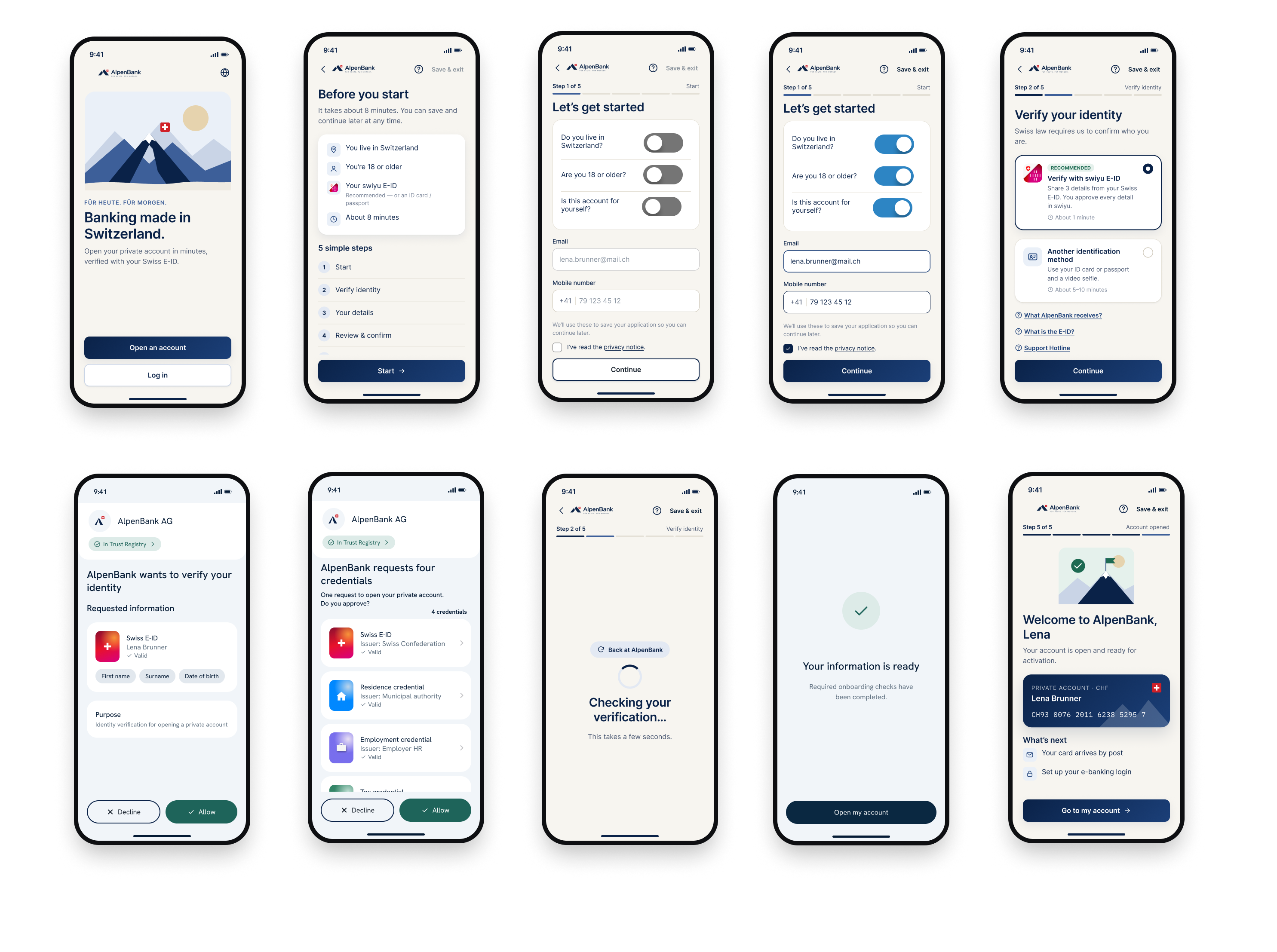
In a decentralized eID model, the bank creates a single digital request.

All four cryptographically signed credentials
When the user taps "Approve," the eID wallet bundles all four cryptographically signed credentials from your phone
The credentials are transmitted securely to the bank in one second.
Foundations
The design principles in this case study (selective disclosure, user-held credentials and unlinkable use) build on the self-sovereign identity model described by Alex Preukschat and Drummond Reed in Self-Sovereign Identity (Manning, 2021).
Manning · Self-Sovereign Identity (2021)From a 3-Day Manual Queue to a <60-stateful onboarding experience
View prototype v2.0
Foundations
The design principles in this case study (selective disclosure, user-held credentials and unlinkable use) build on the self-sovereign identity model described by Alex Preukschat and Drummond Reed in Self-Sovereign Identity (Manning, 2021).
Manning · Self-Sovereign Identity (2021)#1 OUTLINE
How might a traditional Swiss bank integrate swiyu into account opening while reducing manual verification and giving customers greater transparency and control over their data?
AlpenBank is exploring how digital credentials could support a more continuous onboarding experience while still meeting the bank's KYC, AML and tax-reporting obligations. Traditional digital onboarding still requires customers to repeatedly provide and verify information. With Swiss E-ID and swiyu, trusted credentials create an opportunity to change that model.
#2 RESEARCH
How might reusable, trusted digital credentials in the Swiss E-ID ecosystem enable a faster bank onboarding experience while minimising the personal information customers need to disclose?
1.
The bank still needs information to complete its customer dossier. This creates friction for the user experience.
2.
Before consenting, users need to understand who is requesting their information, what is requested and why.
3.
A successful E-ID verification does not necessarily mean the bank's wider KYC process is complete.
#3 HEURISTIC EVALUATION
I evaluated the hybrid bank–swiyu journey against Nielsen Norman Group's 10 usability heuristics, focusing on cross-device continuity, consent, information disclosure and recovery.
Severity 3
While swiyu makes requested information visible before consent, reviewing and completing multiple requests increases interaction effort.
Severity 2
Users need to understand what has already been verified and what remains before account opening.
Severity 2
Users should be able to inspect trust and credential information without losing their place or accidentally committing to disclosure.
Reduce repeated data entry without hiding the complexity of the regulatory process from the customer.
Real-time credential checks
Design target
Less friction, higher completion
Future-state hypothesis
Automation reduces handling
Hypothesised cost
1.
Minimal disclosure
Request only the information required for the specific purpose.
2.
Stateful continuity
Preserve progress across AlpenBank, swiyu and devices.
3.
Clear responsibility
AlpenBank manages onboarding and KYC; swiyu manages credential presentation and consent.
9:41


Für heute. Für morgen.
Banking made in
Switzerland.
Open your private account in minutes,
verified with your Swiss E-ID.
Open an account
Log in
Lena
Information-Overload Professional
Need
Response
Foundations
The design principles in this case study (selective disclosure, user-held credentials and unlinkable use) build on the self-sovereign identity model described by Alex Preukschat and Drummond Reed in Self-Sovereign Identity (Manning, 2021).
Manning · Self-Sovereign Identity (2021)
From a 3-Day Manual Queue to a <60-stateful onboarding experience
#1 OUTLINE
How might a traditional Swiss bank integrate swiyu into account opening while reducing manual verification and giving customers greater transparency and control over their data?
AlpenBank is exploring how digital credentials could support a more continuous onboarding experience while still meeting the bank's KYC, AML and tax-reporting obligations. Traditional digital onboarding still requires customers to repeatedly provide and verify information. With Swiss E-ID and swiyu, trusted credentials create an opportunity to change that model.
#2 RESEARCH
How might reusable, trusted digital credentials in the Swiss E-ID ecosystem enable a faster bank onboarding experience while minimising the personal information customers need to disclose?
1.
The bank still needs information to complete its customer dossier. This creates friction for the user experience.
2.
Before consenting, users need to understand who is requesting their information, what is requested and why.
3.
A successful E-ID verification does not necessarily mean the bank's wider KYC process is complete.
#3 HEURISTIC EVALUATION
I evaluated the hybrid bank–swiyu journey against Nielsen Norman Group's 10 usability heuristics, focusing on cross-device continuity, consent, information disclosure and recovery.
Severity 2
User may not know what has already been completed.
Severity 2
User needs a clear way to inspect information and return.
Severity 3
Completing the regulatory dossier creates repeated interaction.
Reduce repeated data entry without hiding the complexity of the regulatory process from the customer.
Real-time credential checks
Design target
Less friction, higher completion
Future-state hypothesis
Automation reduces handling
Hypothesised cost
Lena
Information-Overload Professional
Need
Response
1.
Minimal disclosure
Request only the information required for the specific purpose.
2.
Stateful continuity
Preserve progress across AlpenBank, swiyu and devices.
3.
Clear responsibility
AlpenBank manages onboarding and KYC; swiyu manages credential presentation and consent.
9:41


Für heute. Für morgen.
Banking made in
Switzerland.
Open your private account in minutes,
verified with your Swiss E-ID.
Open an account
Log in
In a decentralized eID model, the bank creates a single digital request.
All four cryptographically signed credentials
When the user taps "Approve," the eID wallet bundles all four cryptographically signed credentials from your phone
The credentials are transmitted securely to the bank in one second.
Foundations
The design principles in this case study (selective disclosure, user-held credentials and unlinkable use) build on the self-sovereign identity model described by Alex Preukschat and Drummond Reed in Self-Sovereign Identity (Manning, 2021).
Manning · Self-Sovereign Identity (2021)