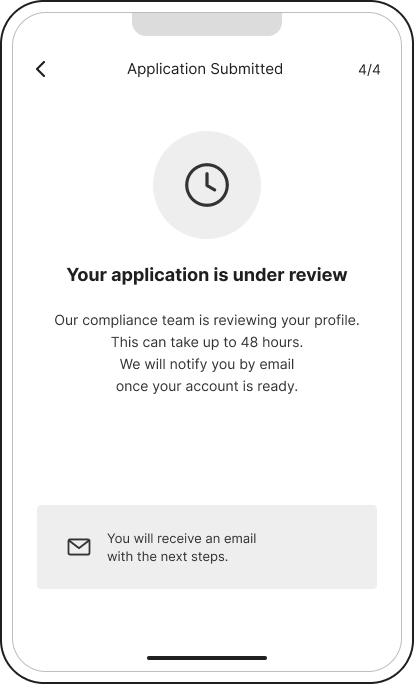
48 h
Time-to-Value (TTV)
The waiting gap
Today · manual KYC

Case studies
About
Services
Contact

Exploring how Swiss e-ID could shift identity verification from repeated identity capture toward trusted digital credentials.
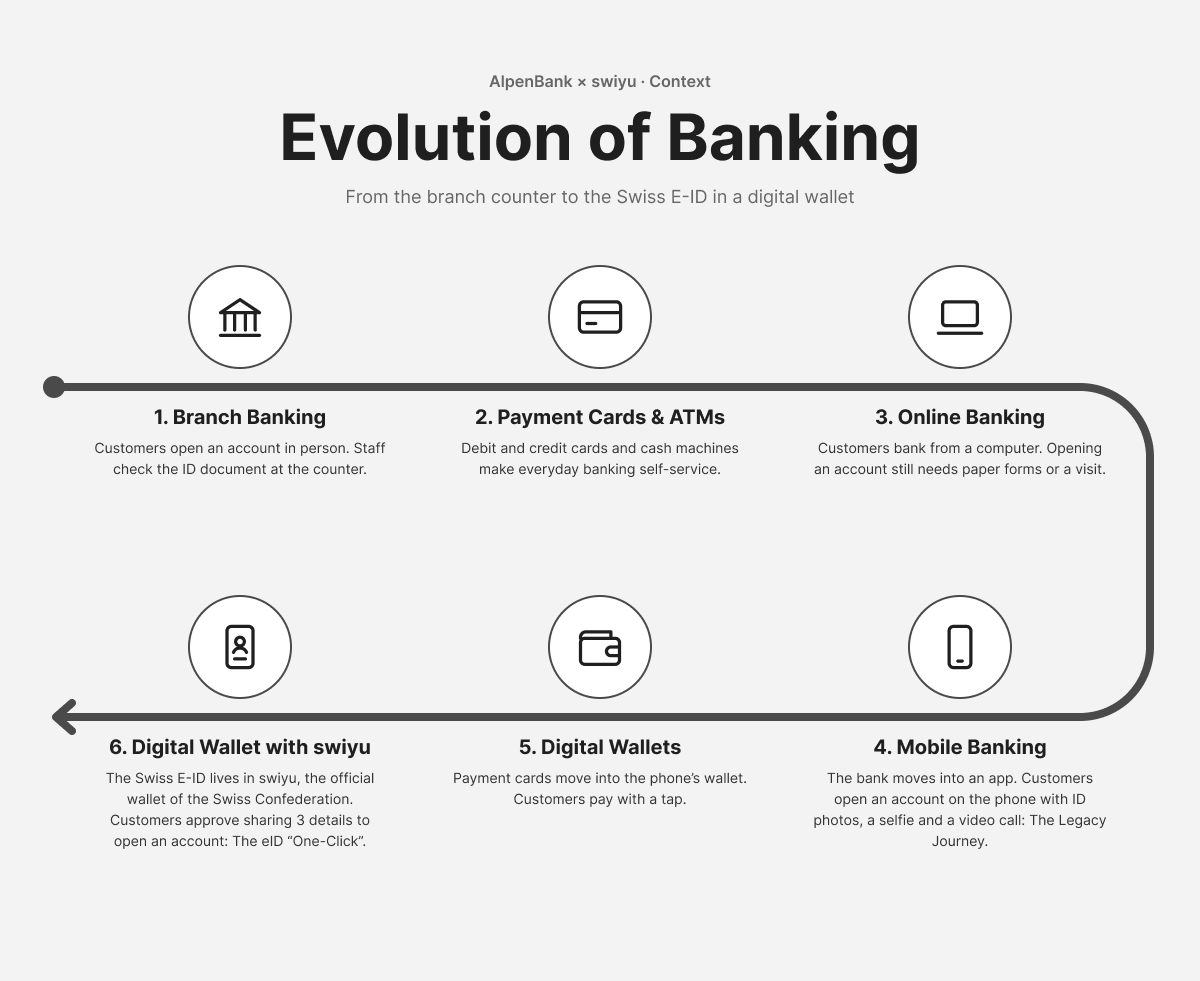
The waiting gap
Today · manual KYC
Friction drives drop-off
Today · manual KYC
Verification vendors and handling
Today · manual KYC
#1 OUTLINE
In a traditional banking setup, gathering all four credentials is a nightmare for the customer. You have to hunt down a passport, scan a utility bill, look up your tax identification number, and request an employment letter from HR. The bank then spends days manually reviewing these documents.
One bank digitised its mortgage decision process and cut time to preliminary approval from several days to one minute.
McKinsey 2014 →
68% of European consumers have abandoned a financial application during onboarding.
Signicat 2022 →
Digital ID can cut customer onboarding costs by up to 90%.
McKinsey Global Institute 2019 →
#2 RESEARCH
How might reusable, trusted credentials in the Swiss E-ID ecosystem make bank onboarding faster, while customers share only the information the bank needs?
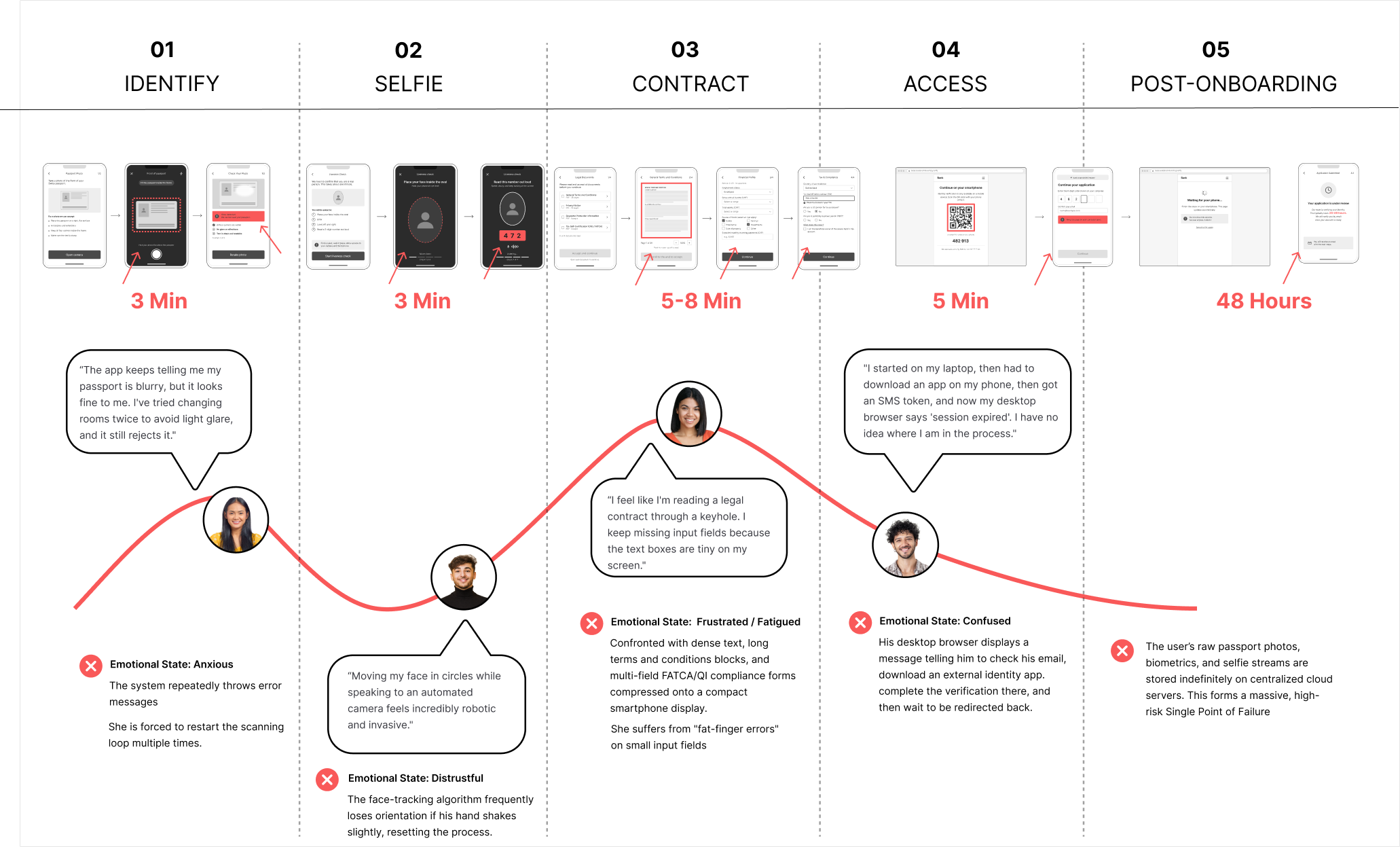
Step-by-Step Opening a Bank Account
Step 1. IDENTIFY
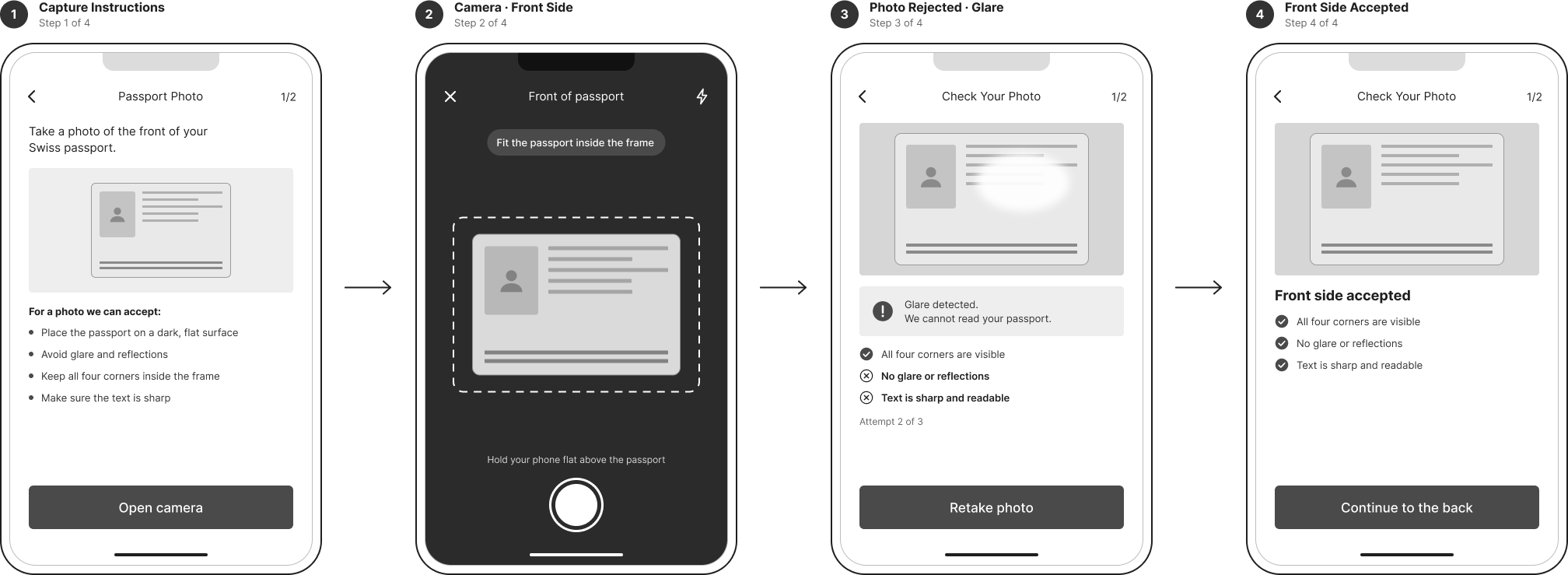
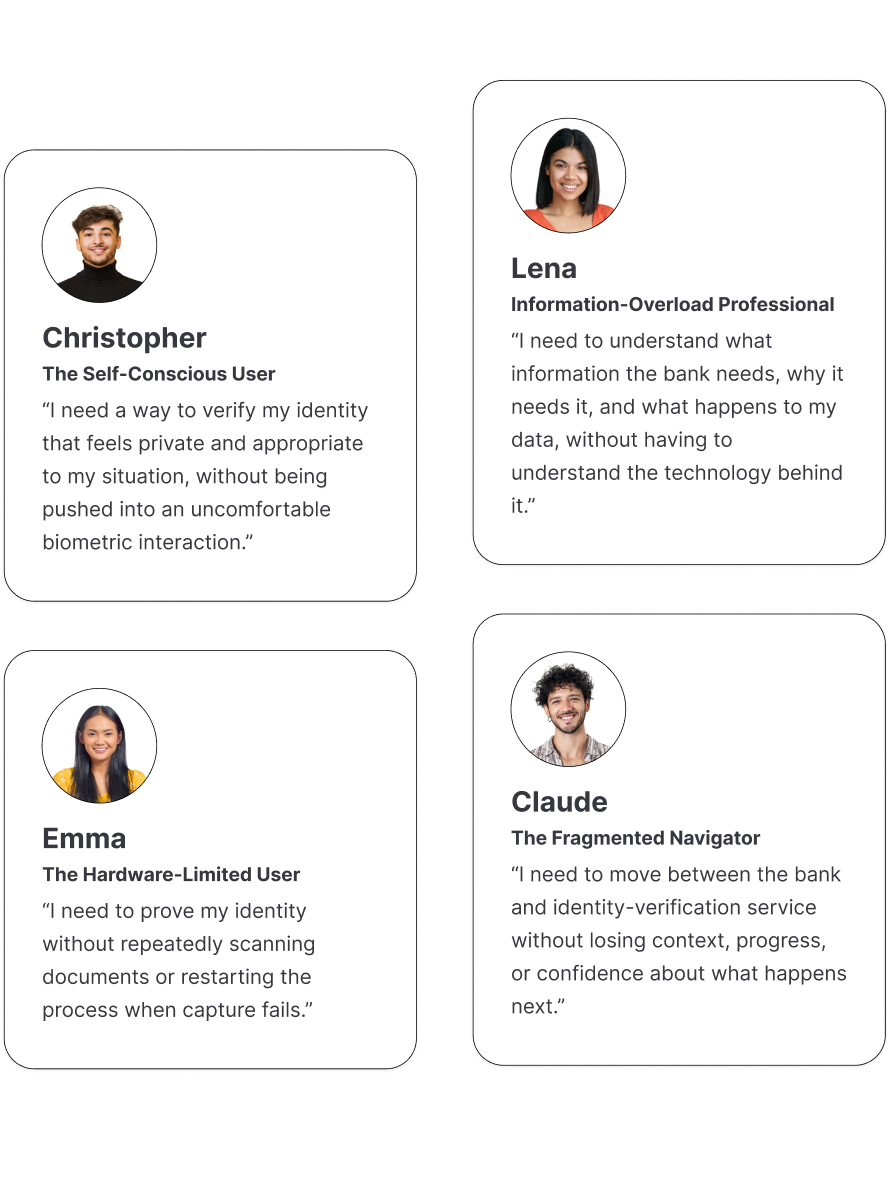
Emma is forced to use her smartphone camera to take a perfect, unglared photo of the front and back of her Swiss passport.
Step 2. SELFIE
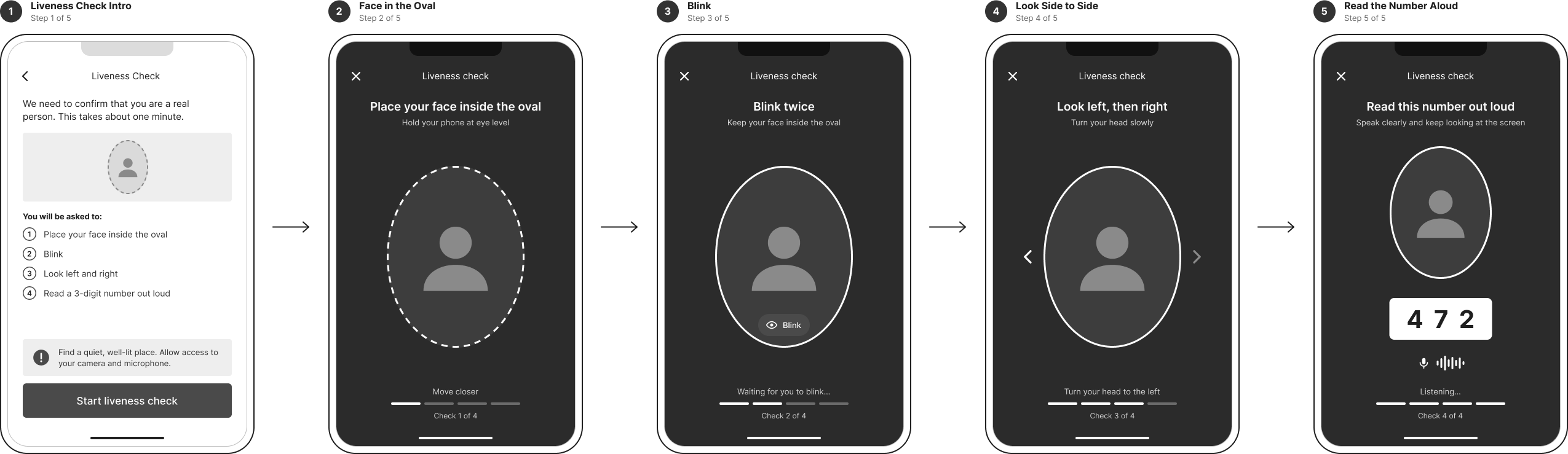
Christopher reaches the "liveness check" phase. The app instructs him to place his face in an on-screen oval, blink, look side-to-side, and read a randomized 3-digit number out loud to prove he is a live human.
Step 3. CONTRACT
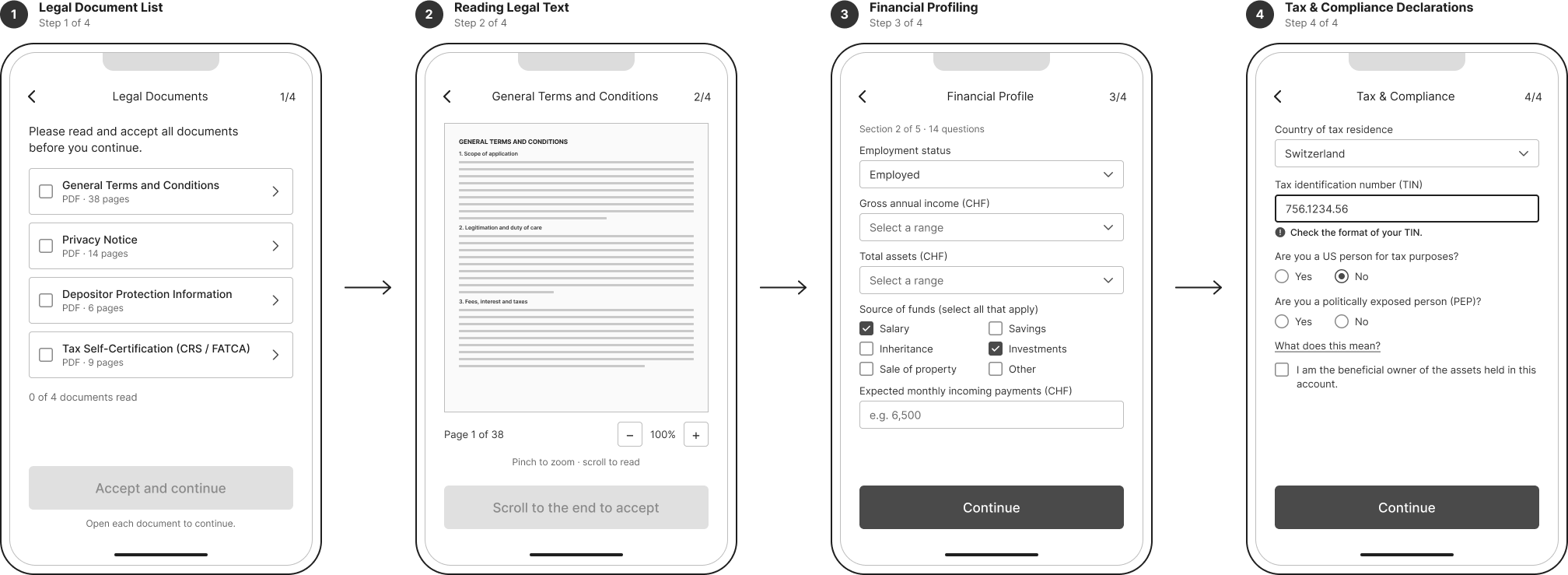
Lena is trying to review legal frameworks and fill out complex financial profiling fields directly on her mobile device.
Step 4. ACCESS
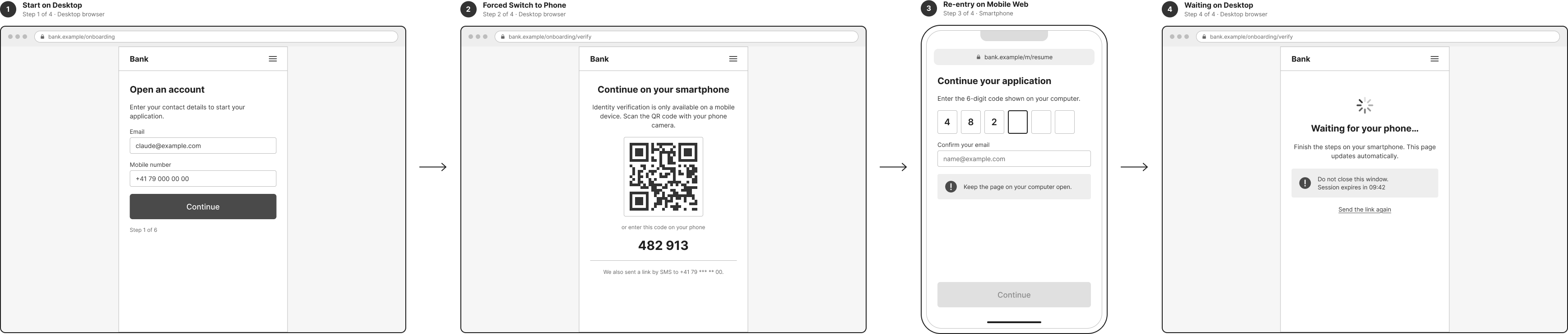
Claude starts on his laptop, but the bank sends him to his phone to scan documents. He loses his place, re-enters details and waits for a code that arrives on the other device.
#3 THE EVOLUTION CONCEPT
In a decentralized eID model, the bank creates a single digital request. When you tap "Approve," your eID wallet bundles all four cryptographically signed credentials from your phone and transmits them securely to the bank in one second.
The bank’s automated compliance system verifies the digital signatures instantly, satisfies its regulatory obligations, and opens your account immediately.
Your data stays with you.
Credentials live in the wallet on your own phone, not in a central database.
Share the proof
The bank receives only the signed facts it needs, such as a verified address, not a copy of your passport.
Nobody is keeping a log
Each use stands alone. The issuer does not learn where you showed your e-ID.
Case study 1 of 3
One journey, three case studies
1 · Today
Transforming Crypto-Banking KYC
48 h · Time-to-Value
● You are here
Foundations
The design principles in this case study (selective disclosure, user-held credentials and unlinkable use) build on the self-sovereign identity model described by Alex Preukschat and Drummond Reed in Self-Sovereign Identity (Manning, 2021).
Manning · Self-Sovereign Identity (2021)Case studies
About
Services
Contact
Exploring how Swiss e-ID could shift identity verification from repeated identity capture toward trusted digital credentials.
The waiting gap
Today · manual KYC
Friction drives drop-off
Today · manual KYC
Verification vendors and handling
Today · manual KYC
#1 OUTLINE
In a traditional banking setup, gathering all four credentials is a nightmare for the customer. You have to hunt down a passport, scan a utility bill, look up your tax identification number, and request an employment letter from HR. The bank then spends days manually reviewing these documents.
Step 1. IDENTIFY
Emma is forced to use her smartphone camera to take a perfect, unglared photo of the front and back of her Swiss passport.
Step 2. SELFIE
Christopher reaches the "liveness check" phase. The app instructs him to place his face in an on-screen oval, blink, look side-to-side, and read a randomized 3-digit number out loud to prove he is a live human.
Step 3. CONTRACT
Lena is trying to review legal frameworks and fill out complex financial profiling fields directly on her mobile device.
Step 4. ACCESS
Claude starts on his laptop, but the bank sends him to his phone to scan documents. He loses his place, re-enters details and waits for a code that arrives on the other device.
#3 THE EVOLUTION CONCEPT
In a decentralized eID model, the bank creates a single digital request. When you tap "Approve," your eID wallet bundles all four cryptographically signed credentials from your phone and transmits them securely to the bank in one second.
The bank’s automated compliance system verifies the digital signatures instantly, satisfies its regulatory obligations, and opens your account immediately.
Your data stays with you.
Credentials live in the wallet on your own phone, not in a central database.
Share the proof
The bank receives only the signed facts it needs, such as a verified address, not a copy of your passport.
Nobody is keeping a log
Each use stands alone. The issuer does not learn where you showed your e-ID.
Case study 1 of 3
One journey, three case studies
1 · Today
Transforming Crypto-Banking KYC
48 h · Time-to-Value
● You are here
Foundations
The design principles in this case study (selective disclosure, user-held credentials and unlinkable use) build on the self-sovereign identity model described by Alex Preukschat and Drummond Reed in Self-Sovereign Identity (Manning, 2021).
Manning · Self-Sovereign Identity (2021)Case studies
About
Services
Contact
The waiting gap
Today · manual KYC
Friction drives drop-off
Today · manual KYC
Verification vendors and handling
Today · manual KYC
One bank digitised its mortgage decision process and cut time to preliminary approval from several days to one minute.
McKinsey 2014 →
68% of European consumers have abandoned a financial application during onboarding.
Signicat 2022 →
Digital ID can cut customer onboarding costs by up to 90%.
McKinsey Global Institute 2019 →
#1 OUTLINE
In a traditional banking setup, gathering all four credentials is a nightmare for the customer. You have to hunt down a passport, scan a utility bill, look up your tax identification number, and request an employment letter from HR. The bank then spends days manually reviewing these documents.
#2 RESEARCH
How might reusable, trusted credentials in the Swiss E-ID ecosystem make bank onboarding faster, while customers share only the information the bank needs?
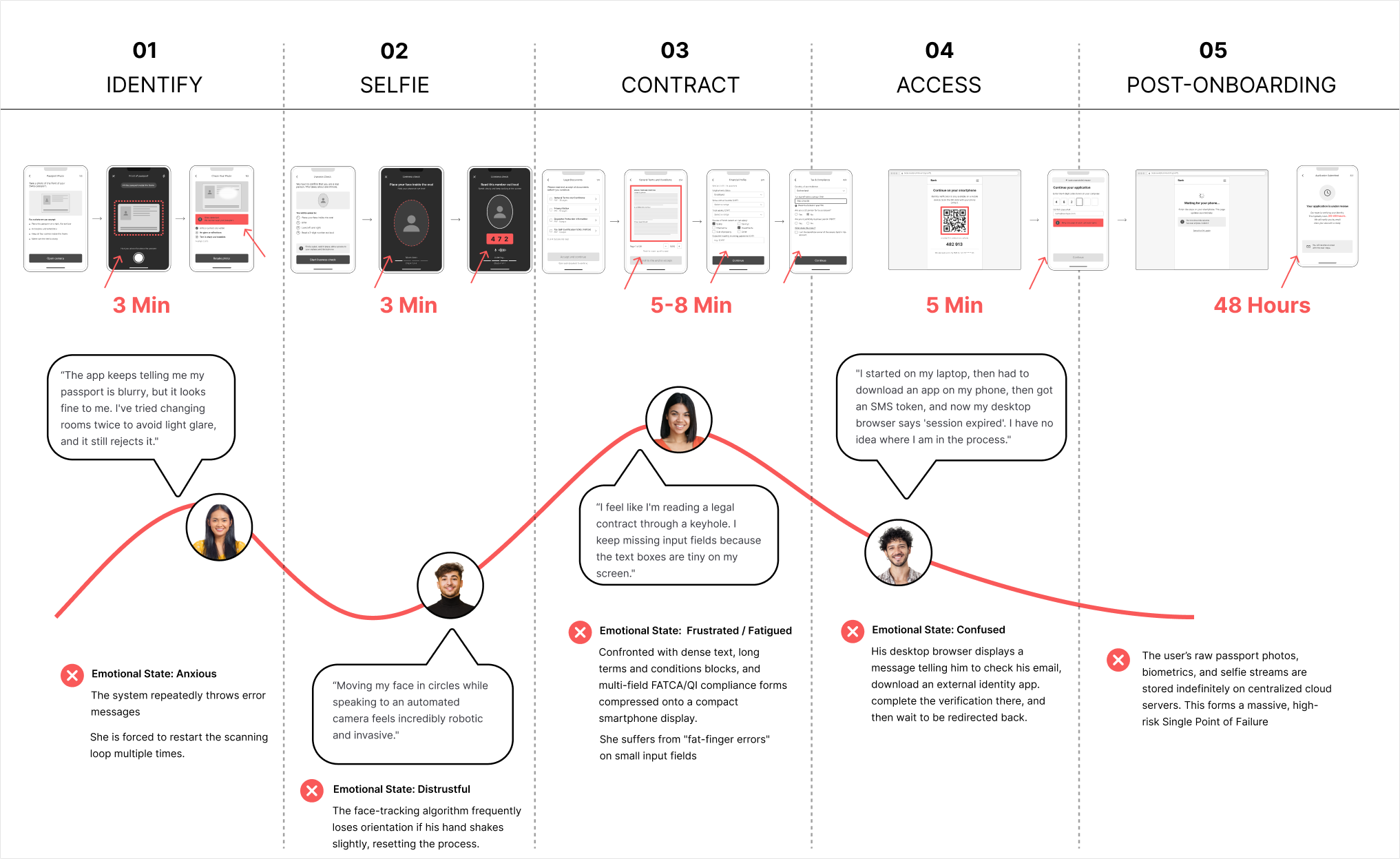
Step-by-Step Opening a Bank Account
Step 1. IDENTIFY
Emma is forced to use her smartphone camera to take a perfect, unglared photo of the front and back of her Swiss passport.
Step 2. SELFIE
Christopher reaches the "liveness check" phase. The app instructs him to place his face in an on-screen oval, blink, look side-to-side, and read a randomized 3-digit number out loud to prove he is a live human.
Step 3. CONTRACT
Lena is trying to review legal frameworks and fill out complex financial profiling fields directly on her mobile device.
Step 4. ACCESS
Claude starts on his laptop, but the bank sends him to his phone to scan documents. He loses his place, re-enters details and waits for a code that arrives on the other device.
#3 THE EVOLUTION CONCEPT
In a decentralized eID model, the bank creates a single digital request. When you tap "Approve," your eID wallet bundles all four cryptographically signed credentials from your phone and transmits them securely to the bank in one second.
The bank’s automated compliance system verifies the digital signatures instantly, satisfies its regulatory obligations, and opens your account immediately.
Your data stays with you.
Credentials live in the wallet on your own phone, not in a central database.
Share the proof, not the document.
The bank receives only the signed facts it needs, such as a verified address, not a copy of your passport.
Nobody is keeping a log
Each use stands alone. The issuer does not learn where you showed your e-ID.
Case study 1 of 3
One journey, three case studies
1 · Today
Transforming Crypto-Banking KYC
48 h · Time-to-Value
● You are here
→
→
Foundations
The design principles in this case study (selective disclosure, user-held credentials and unlinkable use) build on the self-sovereign identity model described by Alex Preukschat and Drummond Reed in Self-Sovereign Identity (Manning, 2021).
Manning · Self-Sovereign Identity (2021)