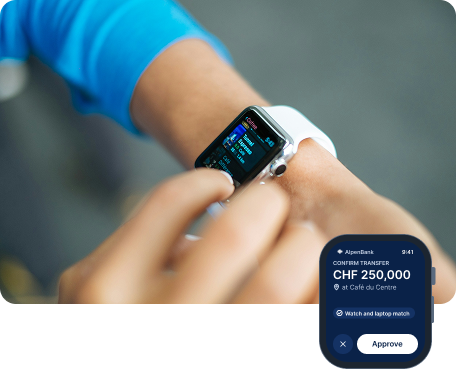
<5 sec
Time-to-Value
A verified customer dossier with one gesture on the wrist. No forms.
Design target

Case studies
About
Services
Contact

A multi-device customer journey blueprint for AlpenBank utilizing spatial computing, smartwatches and conversational zero-knowledge compliance verification.
The future Scenarios
Each persona has one cross-device journey map that tells three scenarios as a single story: Mark's two-day business trip, Elena's long weekend and Stefan's path from a new subsidiary to his own wealth account. Every stage shows what happens, what Peachy says, the device in use and the screens the customer sees, with an emotion curve running underneath. Across all nine scenarios the customer answers with one tap, click or spoken word, and the maps show where the bank, the wallet and the voice agent do the rest.
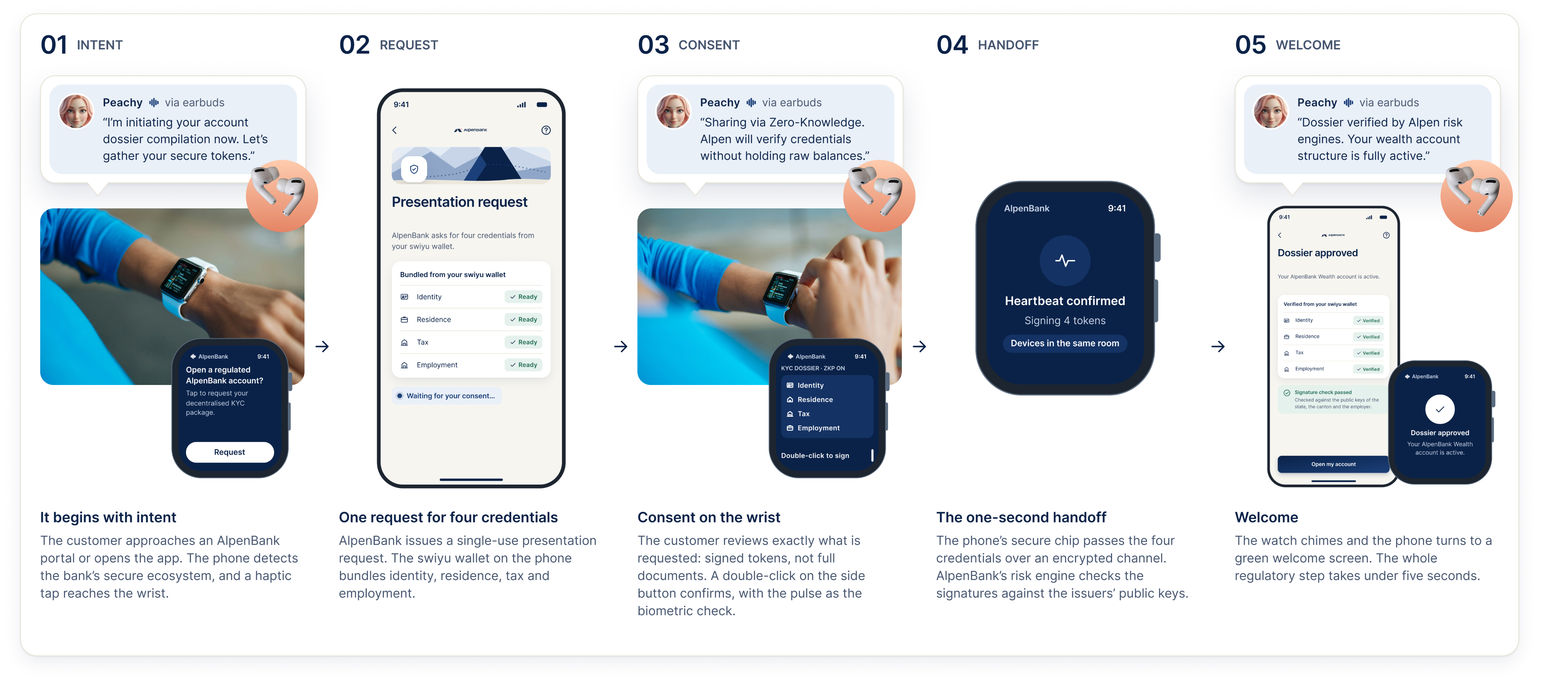

A customer approaches AlpenBank, the swiyu wallet on the phone bundles four verified credentials.
The customer reviews them on the smartwatch and confirms with one gesture.
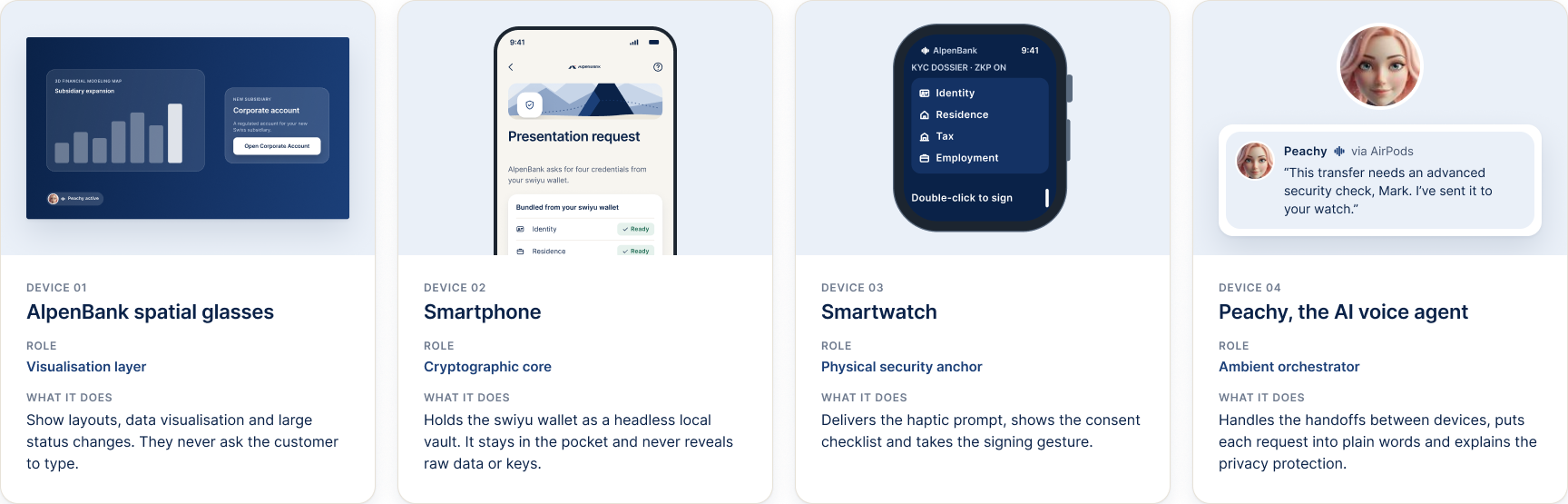
Peachy, the voice agent, explains each handoff between devices.
The design target is a verified customer dossier in under five seconds, without a single form.
A verified customer dossier with one gesture on the wrist. No forms.
Design target
No form fields left to drop out of. Peachy guides every handoff.
Future-state hypothesis
Per product: credentials are reused, so verification is not paid for again.
Hypothesised cost
Four verified credentials replace every field, across all nine scenarios.
Concept principle
How might reusable, trusted digital credentials in the Swiss E-ID ecosystem enable a faster bank onboarding experience while minimising the personal information customers need to disclose?
Photographs a passport, records a selfie with a liveness check, switches from desktop to mobile, and fills in financial and tax forms.
Shares three identity details from the E-ID, then types address, finances and tax on three screens. About 8 minutes.
Approves four credentials in the swiyu wallet on the phone. About 1 minute.
Reviews a checklist on the wrist and confirms with one gesture. Target: under five seconds.
Each part of a task goes to the device that suits the moment. No single device carries the whole onboarding.
Each persona has one cross-device journey map that tells three scenarios as a single story: Mark's two-day business trip, Elena's long weekend and Stefan's path from a new subsidiary to his own wealth account. Every stage shows what happens, what Peachy says, the device in use and the screens the customer sees, with an emotion curve running underneath. Across all nine scenarios the customer answers with one tap, click or spoken word, and the maps show where the bank, the wallet and the voice agent do the rest.
Each persona opens into their profile, a cross-device journey map and three future scenarios in which compliance happens in the background.
PERSONA 1
Mark, 42 · The time-poor executive
PERSONA 2
Elena, 29 · The digital nomad freelancer
PERSONA 3
Stefan, 34 · The connected spatial entrepreneur
1.
The bank still needs information to complete its customer dossier. This creates friction for the user experience.
2.
Example Mark · Wire transfer
3.
Example Stefan · Corporate onboarding
4.
Example Stefan · Corporate onboarding
The future scenario
This is a future scenario, not a shipped product. The specification describes a system concept for decentralised trust rollouts, designed for the landscape from 2027 onwards, and the smartwatch extensions, geofencing and live cross-device handoffs remain pilot concepts.
Case study 3 of 3
One journey, three case studies
3 · Invisible
Zero-form banking
<5 s · Time-to-Value
● You are here
Today the focus is on native smartphone operations, which guarantee the cryptographic hardware binding.
The concept assumes that municipalities, cantons and employers issue residence, tax and employment credentials into the wallet.
The timings are design targets, not measurements: three seconds for Stefan's corporate account and under five seconds for the general onboarding journey.
Foundations
The design principles in this case study (selective disclosure, user-held credentials and unlinkable use) build on the self-sovereign identity model described by Alex Preukschat and Drummond Reed in Self-Sovereign Identity (Manning, 2021).
Manning · Self-Sovereign Identity (2021)Case studies
About
Services
Contact
A multi-device customer journey blueprint for AlpenBank utilizing spatial computing, smartwatches and conversational zero-knowledge compliance verification.
The future Scenarios
Each persona has one cross-device journey map that tells three scenarios as a single story: Mark's two-day business trip, Elena's long weekend and Stefan's path from a new subsidiary to his own wealth account. Every stage shows what happens, what Peachy says, the device in use and the screens the customer sees, with an emotion curve running underneath. Across all nine scenarios the customer answers with one tap, click or spoken word, and the maps show where the bank, the wallet and the voice agent do the rest.
A customer approaches AlpenBank, the swiyu wallet on the phone bundles four verified credentials.

The customer reviews them on the smartwatch and confirms with one gesture.
Peachy, the voice agent, explains each handoff between devices.
The design target is a verified customer dossier in under five seconds, without a single form.
A verified customer dossier with one gesture on the wrist. No forms.
Design target
No form fields left to drop out of. Peachy guides every handoff.
Future-state hypothesis
Per product: credentials are reused, so verification is not paid for again.
Hypothesised cost
Four verified credentials replace every field, across all nine scenarios.
Concept principle
#1 OUTLINE
Zero-form banking is a future concept in which a customer opens a regulated AlpenBank account without filling in a single field. Four verified credentials from the swiyu wallet replace the forms. The customer approves them with one gesture on a smartwatch, and the voice agent Peachy guides each handoff between devices.
The blueprint is designed for the landscape from 2027 onwards. It brings together the official Swiss e-ID in the swiyu wallet, ambient spatial computing and a proactive voice agent. Onboarding moves away from intrusive video identification and paper forms, to cryptographic tokens coordinated across the customer’s own devices.
The concept is told through three customers: Mark, Elena and Stefan. Each has a cross-device journey map with three scenarios, from a branch visit to a corporate account opened in spatial glasses. Every scenario follows the same three stages: intent, consent and approval. The design target is a verified customer dossier in under five seconds.
How might reusable, trusted digital credentials in the Swiss E-ID ecosystem enable a faster bank onboarding experience while minimising the personal information customers need to disclose?
Photographs a passport, records a selfie with a liveness check, switches from desktop to mobile, and fills in financial and tax forms.
Shares three identity details from the E-ID, then types address, finances and tax on three screens. About 8 minutes.
Approves four credentials in the swiyu wallet on the phone. About 1 minute.
Reviews a checklist on the wrist and confirms with one gesture. Target: under five seconds.
Each part of a task goes to the device that suits the moment. No single device carries the whole onboarding.
Each persona opens into their profile, a cross-device journey map and three future scenarios in which compliance happens in the background.
PERSONA 1
Mark, 42 · The time-poor executive
PERSONA 2
Elena, 29 · The digital nomad freelancer
PERSONA 3
Stefan, 34 · The connected spatial entrepreneur
Meet Peachy, the voice that connects the devices. It speaks where the customer already listens: in Mark's AirPods, on Elena's watch and in Stefan's spatial glasses. In every journey it does the same four things.
1.
The bank still needs information to complete its customer dossier. This creates friction for the user experience.
2.
Example Mark · Wire transfer
3.
Example Stefan · Corporate onboarding
4.
Example Stefan · Corporate onboarding
The future scenario
This is a future scenario, not a shipped product. The specification describes a system concept for decentralised trust rollouts, designed for the landscape from 2027 onwards, and the smartwatch extensions, geofencing and live cross-device handoffs remain pilot concepts.
Today the focus is on native smartphone operations, which guarantee the cryptographic hardware binding.
The concept assumes that municipalities, cantons and employers issue residence, tax and employment credentials into the wallet.
The timings are design targets, not measurements: three seconds for Stefan's corporate account and under five seconds for the general onboarding journey.
Case study 3 of 3
One journey, three case studies
3 · Invisible
Zero-form banking
<5 s · Time-to-Value
● You are here
Foundations
The design principles in this case study (selective disclosure, user-held credentials and unlinkable use) build on the self-sovereign identity model described by Alex Preukschat and Drummond Reed in Self-Sovereign Identity (Manning, 2021).
Manning · Self-Sovereign Identity (2021)Case studies
About
Services
Contact
A multi-device customer journey blueprint for AlpenBank utilizing spatial computing, smartwatches and conversational zero-knowledge compliance verification.
The future Scenarios
Each persona has one cross-device journey map that tells three scenarios as a single story: Mark's two-day business trip, Elena's long weekend and Stefan's path from a new subsidiary to his own wealth account. Every stage shows what happens, what Peachy says, the device in use and the screens the customer sees, with an emotion curve running underneath. Across all nine scenarios the customer answers with one tap, click or spoken word, and the maps show where the bank, the wallet and the voice agent do the rest.
A customer approaches AlpenBank, the swiyu wallet on the phone bundles four verified credentials.
The customer reviews them on the smartwatch and confirms with one gesture.
Peachy, the voice agent, explains each handoff between devices.
The design target is a verified customer dossier in under five seconds, without a single form.
A verified customer dossier with one gesture on the wrist. No forms.
Design target
No form fields left to drop out of. Peachy guides every handoff.
Future-state hypothesis
Per product: credentials are reused, so verification is not paid for again.
Hypothesised cost
Four verified credentials replace every field, across all nine scenarios.
Concept principle
#1 OUTLINE
Zero-form banking is a future concept in which a customer opens a regulated AlpenBank account without filling in a single field. Four verified credentials from the swiyu wallet replace the forms. The customer approves them with one gesture on a smartwatch, and the voice agent Peachy guides each handoff between devices.
The blueprint is designed for the landscape from 2027 onwards. It brings together the official Swiss e-ID in the swiyu wallet, ambient spatial computing and a proactive voice agent. Onboarding moves away from intrusive video identification and paper forms, to cryptographic tokens coordinated across the customer’s own devices.
The concept is told through three customers: Mark, Elena and Stefan. Each has a cross-device journey map with three scenarios, from a branch visit to a corporate account opened in spatial glasses. Every scenario follows the same three stages: intent, consent and approval. The design target is a verified customer dossier in under five seconds.
How can ambient voice AI and a distributed experience across spatial computing, smartphones and wearables turn sovereign digital credentials into near-invisible compliance for regulated banking, while maintaining user trust?
Photographs a passport, records a selfie with a liveness check, switches from desktop to mobile, and fills in financial and tax forms.
Shares three identity details from the E-ID, then types address, finances and tax on three screens. About 8 minutes.
Approves four credentials in the swiyu wallet on the phone. About 1 minute.
Reviews a checklist on the wrist and confirms with one gesture. Target: under five seconds.
Each part of a task goes to the device that suits the moment. No single device carries the whole onboarding.
Each persona opens into their profile, a cross-device journey map and three future scenarios in which compliance happens in the background.
PERSONA 1
Mark, 42 · The time-poor executive
PERSONA 2
Elena, 29 · The digital nomad freelancer
PERSONA 3
Stefan, 34 · The connected spatial entrepreneur
Meet Peachy, the voice that connects the devices. It speaks where the customer already listens: in Mark's AirPods, on Elena's watch and in Stefan's spatial glasses. In every journey it does the same four things.
1.
Example Mark · Lounge entry and dossier renewal
2.
Example Mark · Wire transfer
3.
Example Stefan · Corporate onboarding
4.
Example Stefan · Corporate onboarding
The future scenario
This is a future scenario, not a shipped product. The specification describes a system concept for decentralised trust rollouts, designed for the landscape from 2027 onwards, and the smartwatch extensions, geofencing and live cross-device handoffs remain pilot concepts.
Today the focus is on native smartphone operations, which guarantee the cryptographic hardware binding.
The concept assumes that municipalities, cantons and employers issue residence, tax and employment credentials into the wallet.
The timings are design targets, not measurements: three seconds for Stefan's corporate account and under five seconds for the general onboarding journey.
Case study 3 of 3
One journey, three case studies
→
→
3 · Invisible
Zero-form banking
<5 s · Time-to-Value
● You are here
Foundations
The design principles in this case study (selective disclosure, user-held credentials and unlinkable use) build on the self-sovereign identity model described by Alex Preukschat and Drummond Reed in Self-Sovereign Identity (Manning, 2021).
Manning · Self-Sovereign Identity (2021)